1

Motor Matt's Mariner; or, Filling the Bill for Bunce — Edition Insights
16
6
Project Gutenberg
2016
Adventure stories; Dime novels; Railroads -- Juvenile fiction; Jewel thieves -- Juvenile fiction; Mechanics -- Juvenile fiction
Readers of public-domain and historical texts
Project Gutenberg digital edition
en
Edition facts
Words: 37,114
Reading time: 162 min
Text sections: 4
Source:
Project Gutenberg record #53466
This editorial note examines how the opening, middle, and later excerpts of Stanley R. Matthews' dime novel guide a first reading, focusing on the introduction of Motor Matt, the setup of a maritime motor job, and the interplay of trust and deception.
Editorial Edition Score
4.6/5
★★★★★
★★★★★
Calculated from edition completeness, EPUB availability, text structure and catalogue metadata. Not a user rating.
Edition quality
The story opens with Motor Matt and his cowboy chum Joe McGlory on a hotel porch in Catskill-on-the-Hudson, watching river lights. The dialogue immediately establishes Matt's mechanical expertise and McGlory's eagerness for action. The first chapter, titled "Buddha's Eye," hints at an exotic jewel, but the initial conflict is a time-filling errand. This sets a pattern: the plot advances through hired jobs and chance encounters rather than deliberate quests.
The Opening Hook: A Waiting Game
The first excerpt shows Matt and McGlory killing time before a boat to New York. The setting—a hotel porch overlooking the Hudson—is used to introduce the river as both a literal and narrative pathway. Matt's remark about "three long and weary hours" signals a lull that will be filled by a stranger's proposal. The chapter title "Buddha's Eye" dangles a promise of Oriental intrigue, but the immediate business is mundane: a man named Pardo appears, seeking an engineer for a steam yacht. The opening thus primes readers for a story where mechanical skill and quick decisions matter more than premeditated adventure.
The Middle Excerpt: Trust and Its Limits
In Chapter XI, Matt and McGlory debate whether to accept Pardo's offer. McGlory dismisses the Mandarin Tsan Ti's instructions with "Oh, bother the old heathen!"—a line that reveals the casual racism typical of the period. Matt, however, shows caution: he asks the hotel clerk about Pardo and leaves word for Tsan Ti. This moment highlights a recurring tension: Matt balances his role as a hired mechanic with his own judgment. The excerpt also introduces the Iris, a power yacht described with technical detail—"high freeboard forward," "no midship bridge"—that grounds the adventure in real machinery. McGlory's enthusiasm for the boat contrasts with Matt's practical warning about fuel costs, underscoring their different temperaments.
The Later Excerpt: Deception and the Moving Picture
Later in the story, the character Philo Grattan is described as a "talented person who devotes himself to 'tricks that are dark and ways that are vain.'" The character list reveals that Grattan flaunts his crimes through moving pictures—a strikingly modern detail for 1909. This suggests that the narrative may use media as a plot device, though the excerpts do not show how. The presence of a "crafty Oriental" Mandarin and a jewel thief ("Buddha's Eye") points to a layered scheme, but the excerpts leave unclear how these threads connect. Readers should note that the story's title promises a mariner (Bunce) who "fills the bill"—likely a role that becomes clear only in the final chapters.
Reading the Serial Structure
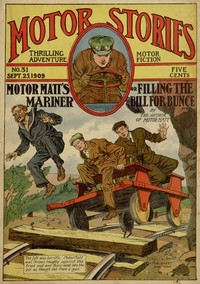
This book was originally a dime novel, issued weekly as part of the Motor Stories series. The excerpts show a formula: each chapter ends with a decision or a cliffhanger, such as Matt agreeing to meet Pardo at eight-thirty. The serial format means that characters are introduced with quick sketches—McGlory is "a young cowboy who proves himself a lad of worth," Grattan is "a man fitted by nature for a worthier part." These descriptions, placed before the story begins, act as a dramatis personae. For a first reading, paying attention to these character notes helps track who is trustworthy. The story's reliance on motorboats, trains, and mechanical expertise also means that technical details are not decoration but clues to how problems will be solved.
As you read, note how Matt's mechanical authority is established through small actions—asking about payment, inspecting the yacht, leaving word at the hotel. These details build a protagonist who is competent but not reckless. The excerpts suggest that the plot will hinge on misdirection and hidden identities, so watch for discrepancies between what characters say and what they do. The title's promise of a mariner "filling the bill" may be fulfilled in an unexpected way.
Reader reflection
What was your reading experience?
Capture what you thought, learned, and would like to remember.
Your progress
0
/
10
2
What was your overall reaction to the book?
3
Is this a title you would suggest to others?
4
How much effort did this book require?
5
How would you describe its reading pace?
6
Was the book easy to understand?
7
Would you like to discuss this book with someone?
8
How personally connected did you feel to the book?
9
Which lesson or insight stayed with you?
10