1

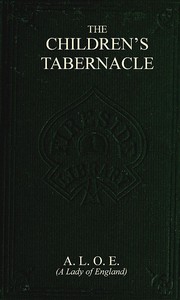
The Children's Tabernacle; Or, Hand-Work and Heart-Work — Inside the Classic
6
0
Project Gutenberg
2015
Christian life -- Juvenile fiction; Siblings -- Juvenile fiction; Parent and child -- Juvenile fiction; Bible stories, English -- Juvenile fiction; Tabernacle -- Juvenile fiction
Readers of public-domain and historical texts
Project Gutenberg digital edition
en
Edition facts
Words: 42,440
Reading time: 185 min
Text sections: 6
Source:
Project Gutenberg record #49643
A.L.O.E.'s 1875 religious novel follows the Vincent children as they build a model of the biblical Tabernacle, intertwining their handiwork with moral lessons on sin, repentance, and faith. The story contrasts the earnest efforts of sickly Agnes with the self-deceiving industry of her twin Dora, using the Tabernacle's construction to explore inner versus outer devotion.
Editorial Edition Score
4.7/5
★★★★★
★★★★★
Calculated from edition completeness, EPUB availability, text structure and catalogue metadata. Not a user rating.
Edition quality
The Vincent children's project to build a model of the biblical Tabernacle is introduced not as a mere craft but as a test of character. From the opening chapter, the narrative pairs physical labor—cutting pasteboard, stitching curtains—with spiritual introspection. The author, A.L.O.E., signals that the model's details (the curtains of fine linen, the gold-covered boards) will serve as tangible prompts for discussing deeper truths. The preface explicitly asks whether such 'deep and difficult' subjects can be made intelligible to the young, and the story answers by embedding doctrinal conversations within domestic scenes. Readers should note how the children's varying responses to the work—eager, dutiful, or evasive—foreshadow their moral trajectories.
Hand-Work as a Mirror for Heart-Work
The title's pairing of 'Hand-Work and Heart-Work' is not decorative; it structures the entire narrative. Each chapter advances the model's construction while simultaneously exposing the inner state of the child at work. When Dora sews on a Sunday, she resolves to 'unpick on the Monday morning all that she had sewn on the Sunday afternoon'—a plan that the narrator calls a 'contrivance for quieting conscience.' Her outward diligence masks a refusal to confess sin. In contrast, Agnes, though physically weaker, uses the same sewing to meditate on 'the Fountain open to her, in which she could wash and be clean.' The model becomes a diagnostic tool: the same actions reveal opposite spiritual conditions.
The Tabernacle as a Typological Primer
A.L.O.E. weaves explicit typological teaching into the plot. The children learn that the Tabernacle's curtains, altars, and sacrifices 'shadow forth' Christ. One chapter is titled 'Types,' and the narrative pauses for a father-led explanation of how Old Testament symbols prefigure Gospel realities. The author's preface stresses that such reading is crucial 'especially in these perilous times.' Yet the typology is never abstract; it is tied to the children's immediate struggles. When Agnes feels 'bitten by the serpent of sin,' she recalls the bronze serpent of Numbers 21. The model is a mnemonic device, making doctrine tactile. Readers unfamiliar with typology will find the lessons embedded in dialogue, not lectures.
Contrasting Sisters: Agnes and Dora
The twin sisters, Agnes and Dora, embody the book's central moral polarity. Both work on the same model, but their motivations diverge sharply. Agnes, described as 'sickly' and disturbed by a cough, struggles against inward sin with 'hope' and 'courage.' Dora, 'more vigorous,' channels her energy into embroidery patterns while avoiding self-examination. The narrator explicitly warns that 'a great many persons—even grown-up persons—act, alas! like Dora,' focusing on 'outward things in religion' while neglecting 'the cleansing of the heart.' Their parallel actions—rising early, sewing diligently—are rendered in nearly identical prose, heightening the contrast. Readers should watch for how each sister's private thoughts, revealed in asides, diverge from their shared behavior.
The Role of the Parent-Teacher
The preface urges parents to read the book 'with' children, prepared to answer questions. This directive shapes the narrative: adults in the story—particularly the father—interrupt the children's work to explain types, correct misunderstandings, and apply lessons. When Dora tries to 'banish from her mind all thought' of a conversation on leprosy as a type of sin, the father's earlier teaching lingers as an uncomfortable presence. The book models a method of domestic religious instruction where manual activity and oral explanation cooperate. The children's questions (e.g., about the meaning of the curtains) are not rhetorical; they drive the exposition. This makes the text as much a guide for parents as a story for children.
Readers will benefit from tracking how each child's relationship to the model evolves across the twenty-one chapters. The excerpts reveal a pattern: a chapter on construction is followed by one on moral application, then a return to the model. This rhythm rewards attention to small details—a dropped stitch, a hammer blow, a rainy morning—that carry symbolic weight. The book does not resolve the twins' conflict in the provided excerpts, leaving their fates open. Approach the text as a layered work where the physical model and the spiritual lesson are meant to be read together, each illuminating the other.
Reader reflection
Your personal reading reflection
Build a private reading journal entry for this title.
Your progress
0
/
10
2
Did this book hold your interest?
3
Would you pass this book on to a friend?
4
What was the reading difficulty like?
5
How useful were the ideas in this book?
6
How strong was your personal connection to the text?
7
Would a second reading be valuable?
8
Was the book moving at the right speed?
9
In one sentence, what did you learn?
10