
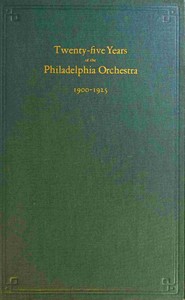
Twenty-five years of the Philadelphia Orchestra, 1900-1925 by Frances Anne Wister
Frances Anne Wister's Twenty-five years of the Philadelphia Orchestra, 1900-1925 is a unique piece of history. It's not written by a distant scholar, but by someone who was right there in the middle of it all. Wister was a founding member and a driving force behind the orchestra's Women's Committee, giving her a front-row seat to every triumph and crisis.
The Story
The book chronicles the orchestra's journey from a bold idea to a world-class institution. It starts with a simple question: Why doesn't Philadelphia, one of America's great cities, have a permanent professional orchestra? Wister takes us through the early meetings in drawing rooms, the frantic fundraising to secure the massive $25,000 guarantee needed for the first season, and the hiring of the brilliant but demanding conductor, Fritz Scheel. We see the growing pains: financial panic, disagreements over musical programming (should they play modern composers or stick to the classics?), and the constant struggle to fill the hall. The narrative follows the baton through conductors like Carl Pohlig and finally to the legendary Leopold Stokowski, whose arrival marked the beginning of a new, glamorous era. It's the story of an artistic experiment that became an essential part of a city's identity.
Why You Should Read It
What makes this book special is its perspective. You feel the nervous energy of those first concerts and the sheer relief when they were a success. Wister doesn't hide the messy parts—the personality clashes, the times they almost went bankrupt, the debates that nearly split the board. She shows that building something lasting is hard work, filled with committee meetings and budget sheets as much as with beautiful music. Her writing is filled with character sketches of the wealthy patrons, determined musicians, and visionary leaders who made it happen. You come away understanding that an orchestra is more than musicians on a stage; it's a community effort.
Final Verdict
This is a must-read for anyone who loves Philadelphia, is fascinated by early 20th-century American culture, or has ever sat in a concert hall and wondered, 'How did this all start?' It's perfect for history buffs who prefer stories about people over dry dates and facts, and for music lovers curious about the business side of art. While it's a specific history, the core themes—civic pride, artistic ambition, and the grind of making a dream real—are universal. Just be prepared to look at your local symphony in a whole new light.
No rights are reserved for this publication. Share knowledge freely with the world.
Aiden Brown
2 years agoFive stars!
Emma Jackson
3 months agoSolid story.
Christopher Lopez
1 year agoJust what I was looking for.
Amanda Clark
1 year agoI started reading out of curiosity and the atmosphere created is totally immersive. This story will stay with me.






Sarah Rodriguez
5 months agoThanks for the recommendation.