
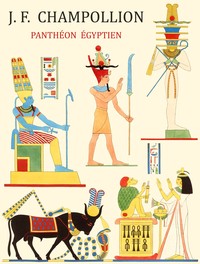
Panthéon égyptien : Collection des personnages mythologiques de l'ancienne…
Let's be clear: this isn't a novel. There's no fictional plot. But the story it tells is more gripping than many thrillers. "Panthéon égyptien" is the record of a monumental breakthrough. For centuries, the writings of ancient Egypt were just decoration—beautiful, mysterious, and utterly silent. Scholars argued over their meaning without a way to prove anything. Then came Jean-François Champollion, a French linguist who became convinced the Rosetta Stone held the answer.
The Story
This book is his field guide. Think of it as his working notebook, published for the world. He didn't just want to list gods; he wanted to understand the system. Champollion realized that the hieroglyphs weren't just pictures. Some stood for sounds, some for ideas, and the names of gods within cartouches (those oval loops) were his Rosetta Stone within the Rosetta Stone. By comparing the Greek names on the Stone with the hieroglyphic symbols, he started to match sounds to symbols. This book organizes the Egyptian pantheon, but in doing so, it demonstrates his new grammar. Each entry for a deity like Thoth or Anubis is an example of his code in action, showing how their names were written and, by extension, how the language worked.
Why You Should Read It
What's amazing is feeling the excitement of discovery on the page. This isn't a cold, settled history. It's a report from the frontier. You see Champollion building his case, using the gods as his primary evidence. You get a real sense of his mind at work—how he connected dots between different inscriptions and used logic to untangle a script everyone thought was purely symbolic. It makes the gods feel less like distant myths and more like active characters in the story of decipherment. Their images and names were the clues that cracked the case.
Final Verdict
Perfect for history buffs, puzzle lovers, or anyone who's ever wondered how we know what we know about the ancient world. It's not a light read—it's a 19th-century scholarly work—but it's a foundational one. If you enjoy shows or books about code-breaking, or if you love Egyptian history and want to see the 'how' behind it, this is a rewarding deep dive. You're not just reading about gods; you're witnessing the birth of Egyptology.
This is a copyright-free edition. Thank you for supporting open literature.
Mary White
2 years agoI came across this while browsing and the depth of research presented here is truly commendable. Thanks for sharing this review.
Thomas Allen
1 year agoGreat digital experience compared to other versions.
Jackson King
1 year agoThis is one of those stories where the clarity of the writing makes this accessible. I couldn't put it down.
Joshua Thomas
1 year agoI had low expectations initially, however the clarity of the writing makes this accessible. One of the best books I've read this year.





Mason Miller
3 months agoAfter finishing this book, the storytelling feels authentic and emotionally grounded. Truly inspiring.