
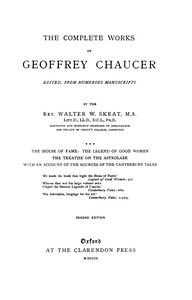
Chaucer's Works, Volume 3 — The House of Fame; The Legend of Good Women; The…
This third volume of Chaucer's works feels like stepping into the poet's private workshop. We're far from the crowded road to Canterbury here. Instead, we get two longer poems that show a different side of the man often called the 'father of English literature.'
The Story
First up is 'The House of Fame,' a trippy, unfinished dream-vision. The poet falls asleep and an eagle—who talks, by the way—carries him through the sky to a strange castle. This isn't just any castle; it's a twisting, turning place made of tidings, news, and whispers. It’s where every piece of gossip and every story ever told eventually ends up, twisting and changing shape. It's Chaucer's way of asking how fame and truth work in a world full of talk.
Then, in 'The Legend of Good Women,' the tone shifts. Chaucer casts himself as the main character, getting a serious scolding from the God of Love and his queen, Alceste. They're furious because he wrote poems (like 'Troilus and Criseyde') that portrayed women as unfaithful. As penance, he has to write a series of 'legends' about classical heroines—women like Cleopatra, Dido, and Lucrece—who were famously virtuous and often tragic. It's part love-letter, part homework assignment, and you can almost hear him sigh as he starts each one.
Why You Should Read It
What I love about this collection is how personal it feels. In 'The House of Fame,' you see Chaucer the observer, fascinated and a little overwhelmed by how messy human communication is. In 'The Legend,' you meet Chaucer the professional writer, caught between his art, his patrons, and the expectations of his time. The poems are filled with his signature wit and eye for detail, but there's a self-awareness here that's really compelling. He's not just telling stories; he's thinking about storytelling—its power, its dangers, and its responsibilities.
Final Verdict
This book is perfect for anyone who enjoyed The Canterbury Tales but wants to see more of the man behind the pilgrims. It's also a great pick for readers who like smart, playful poetry that isn't afraid to get philosophical. If you're curious about medieval ideas on fame, love, and guilt, told with a wink and a nudge, you'll find a lot to chew on here. Just be ready for an eagle with a lot of opinions and a poet trying to talk his way out of trouble.
No rights are reserved for this publication. Enjoy reading and sharing without restrictions.
Patricia Walker
3 months agoFrom the very first page, it challenges the reader's perspective in an intellectual way. Worth every second.
Jessica Lopez
1 year agoIf you enjoy this genre, it manages to explain difficult concepts in plain English. A valuable addition to my collection.




Donna Davis
6 months agoGreat read!