
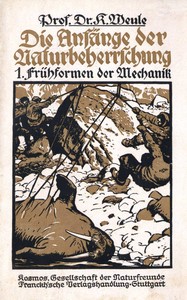
Die Anfänge der Naturbeherrschung. 1. Frühformen der Mechanik by Karl Weule
Karl Weule's book isn't a story in the traditional sense—there's no main character or plot twist. Instead, it tells the story of an idea: humanity's earliest attempts to understand and use physical force. Think of it as a detective story about our own species. Weule acts as a guide, sifting through archaeological finds and historical accounts to piece together how ancient cultures across the globe began to master simple machines.
The Story
Weule starts at the very beginning, long before written history. He examines the evidence: notched bones that might be early levers, pottery wheels that hint at rotational motion, and the construction of massive monuments like pyramids, which demanded an understanding of force and friction. He walks us through the incremental development of basic mechanical principles—the lever, the wedge, the ramp, the pulley. The "plot" is the slow, collective dawning of mechanical understanding, moving from pure muscle power to using nature's own rules to gain an advantage. It's about the transition from just doing things to figuring out how to do them better.
Why You Should Read It
What makes this book special is how it makes you see the modern world differently. After reading it, you'll look at a pair of scissors, a wheelbarrow, or even a can opener not as finished products, but as the latest chapter in a very long story. Weule connects these ancient innovations directly to our lives. He shows that the drive to build a better mouse trap (or a better way to grind grain) is a fundamental part of being human. It's surprisingly humbling and empowering to realize that the basic toolkit for civilization was assembled piece by piece over millennia, often by anonymous inventors whose names are lost to time.
Final Verdict
This book is perfect for curious minds who enjoy history, science, or just understanding how things work. It's not a light read—it requires a bit of focus—but it's deeply rewarding. If you're a fan of authors like James Burke or enjoy shows that connect the dots of technological history, you'll find a kindred spirit in Karl Weule. It's for the reader who looks at a simple machine and wonders, "Who was the first person to think of that?" This book provides the fascinating, well-researched answers.
Legal analysis indicates this work is in the public domain. You are welcome to share this with anyone.
Joseph Allen
2 years agoClear and concise.
Daniel King
4 months agoGreat read!
Elijah Flores
7 months agoGreat read!
Margaret Hernandez
5 months agoThe formatting on this digital edition is flawless.





Paul Hernandez
1 year agoAmazing book.